A water transfer film is floated on the surface of a tank, activated, and then the shell is pressed down through it. Water pressure pushes the pattern into every recess, around every corner radius, and over the outer rim — places where a formed film simply cannot stretch. It is the only process we run that covers the extreme edge of a phone case. It is also hand-made, which is why it costs more and starts at 500 pieces.
500 pcs/design   7–10 days    US$1.15–1.65   100%
per model        sample       TPU / PC       full coverage
What happens in the tank
Four steps, and none of them can be automated.
- Float. A water-soluble film printed with your pattern is laid flat on the water surface.
- Activate. A solvent is sprayed onto the film. It dissolves the carrier and leaves the ink as a floating skin, still holding your design.
- Dip. The shell is lowered through the floating ink at a controlled angle. Water pressure — not air, not a press — folds the pattern onto the surface and into every recess.
- Cure. The part is rinsed, dried, and then clear-coated. The coat is what the part is actually touched through.
Why the tank works where a press does not: there is no film to stretch. The pattern is already liquid-borne and conformal by nature, so the limit is not the material’s elongation — it is only whether water can reach the surface. On a phone case, water reaches everything.
The one thing this process does that others cannot
Every other full-wrap method has a limit somewhere:
- Full wrap IMD needs a film formed to the shell geometry. At the outer rim and the deepest corner radii, the film cannot stretch that far, and a sliver of bare plastic remains.
- 3D sublimation wraps well, but tight internal radii around the camera cut-out can leave bare edges.
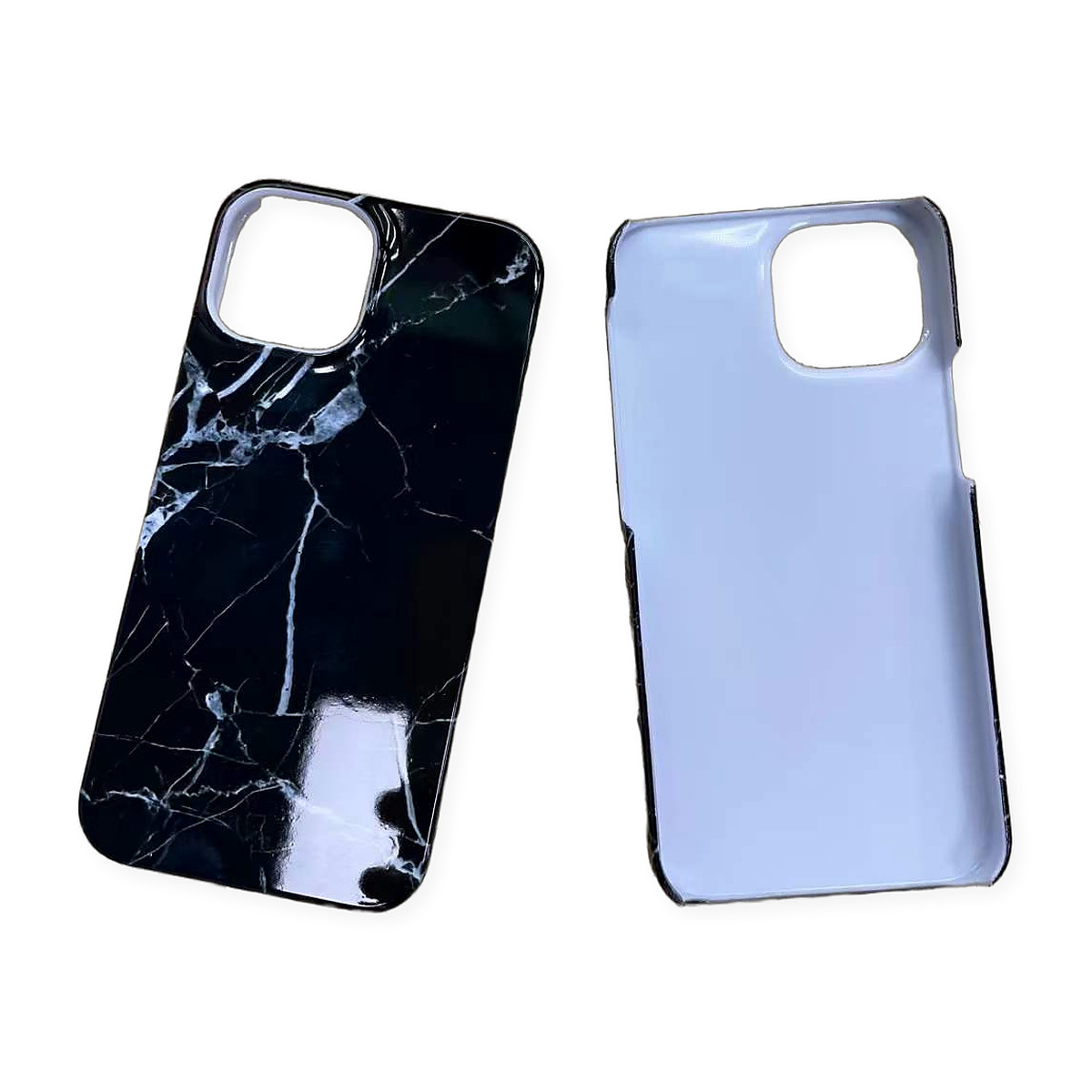
Water transfer does not have that boundary. The ink goes wherever water goes. The outermost rim, the tightest corner, the inside of the port cut-outs — all covered, continuous, with no seam and no bare line.
If your design runs edge to edge and any bare plastic at the rim would be visible, this is the process. That specific requirement is what the price pays for.
It is made by hand — and that is the real cost
We are direct about this, because it explains both the price and the minimum.
Each shell is dipped individually by an operator. The angle of entry, the speed of the dip, and the moment of activation are all judged by hand. A skilled operator produces a fraction of what an injection moulding machine turns out in the same hour.
Two consequences:
- The unit price is the highest of our four pattern processes. Not because the materials are expensive, but because a person touches every piece.
- 500 pieces per design per model is the floor. Below that, the set-up — printing the film, tuning the tank, dialling in the dip for your specific shell — cannot be recovered.
What hand-work buys you: consistency of coverage, not consistency of position. A machine wraps the same way every time but cannot reach the extremes; a person adapts to each shell and reaches everywhere. If your design has to be perfectly centred to a tolerance, this is the wrong process.
Durability, and the top coat
Bare water transfer film is not the most abrasion-resistant finish. A coin edge will leave a mark. We do not pretend otherwise.
What we do about it: every water transfer part is clear-coated by default — either UV gloss or a matte lacquer — unless you specifically ask for bare film. The coat is what takes the wear; the pattern underneath stays intact.
With a good coat the surface handles keys, pockets and daily handling the way any coated shell does. It will not outlast IMD, because IMD has no surface layer to wear at all. Choose accordingly:
- Two years of hard use, no visible wear → IMD
- Full coverage to the very edge, with a top coat → water transfer
- Full coverage on a hard shell, mid volume → 3D sublimation
What patterns suit it
Strong:
- Wood grain, marble, stone, carbon fibre, brushed metal
- Camouflage, animal print, geometric repeats
- Full-colour photography that needs to run around the sides
- Any design where the pattern must continue across the rim
Weak:
- Fine lines thinner than about 0.3 mm — they soften in the dip
- A logo that must sit at an exact position — hand-dipped registration varies
- Flat solid colours — spray coating is cheaper and cleaner
When water transfer is the wrong choice
- Your order is under 500 pieces. The set-up cost cannot be absorbed. Use sublimation or IMD.
- You need the graphic to be un-scratchable. The pattern sits under a coat, not inside the plastic. That is IMD.
- Your artwork is simple and flat. You are paying for coverage you do not need.
- You need a hard PC shell and full wrap at low volume. Sublimation does that for less.
Specifications
| Item | Detail |
|---|---|
| Substrate | TPU, PC |
| Coverage | 100% — back, all four sides, outer rim, cut-outs |
| Colour | Full colour, photographic |
| Minimum | 500 pcs per design per model |
| Sampling | 7–10 days |
| Production | 7–15 days |
| Unit price | US$1.15–1.65 |
| Finish | UV gloss or matte lacquer, applied by default |
| Artwork | AI / PDF / PSD at 300 dpi, seamless tile preferred for repeats |
| Method | Hand-dipped, individually |
Note on repeats: if your design is a repeat pattern (wood grain, marble, camo), send it as a seamless tile. A tile gives the operator a continuous film and produces a better wrap than a single flat image.
FAQ
Does the pattern really cover the outer rim?
Yes. That is the reason to choose this process. Water pressure carries the ink over the rim and into the corner radii. We will show you the rim on your sample, not just the back.
Will it peel at the edges?
No peeling, because there is no edge — the film is washed away after transfer and the pattern is continuous. What wears is the clear coat, and that can be re-applied.
Can I use my own photograph?
Yes, at 300 dpi or better, sized so the pattern continues across the sides. We will show you a wrap proof on the actual shell shape before dipping your batch.
How close can you match a Pantone colour?
Close on large solid areas, but this is a wet process on a curved surface. Exact Pantone is not achievable. We send a physical colour sample first.
Why is the minimum 500 pieces?
Because every design requires its own film print, its own tank set-up and its own dip tuning. Those are fixed costs per design, and 500 pieces is where they stop dominating the unit price.
Can you do a matte finish?
Yes — matte lacquer instead of UV gloss. Matte is slightly less abrasion-resistant than gloss, so we will tell you if your use case calls for gloss.
Send your pattern — we will proof it on your shell shape before we dip a single production piece.
Include the phone model, the number of patterns, and the quantity per pattern. If your design must reach the outer rim, say so — that is the one requirement that makes this process the right answer.
On confidentiality: what you send us stays with us. We never disclose your artwork, designs or product information to any third party without your written consent — and we sign an NDA before you share a single file.
Send us what you are making.
Model, quantity and the artwork you already have is enough to start. You get a price range and a lead time within one working day — no account, no ticket queue, no waiting for a form to be read.