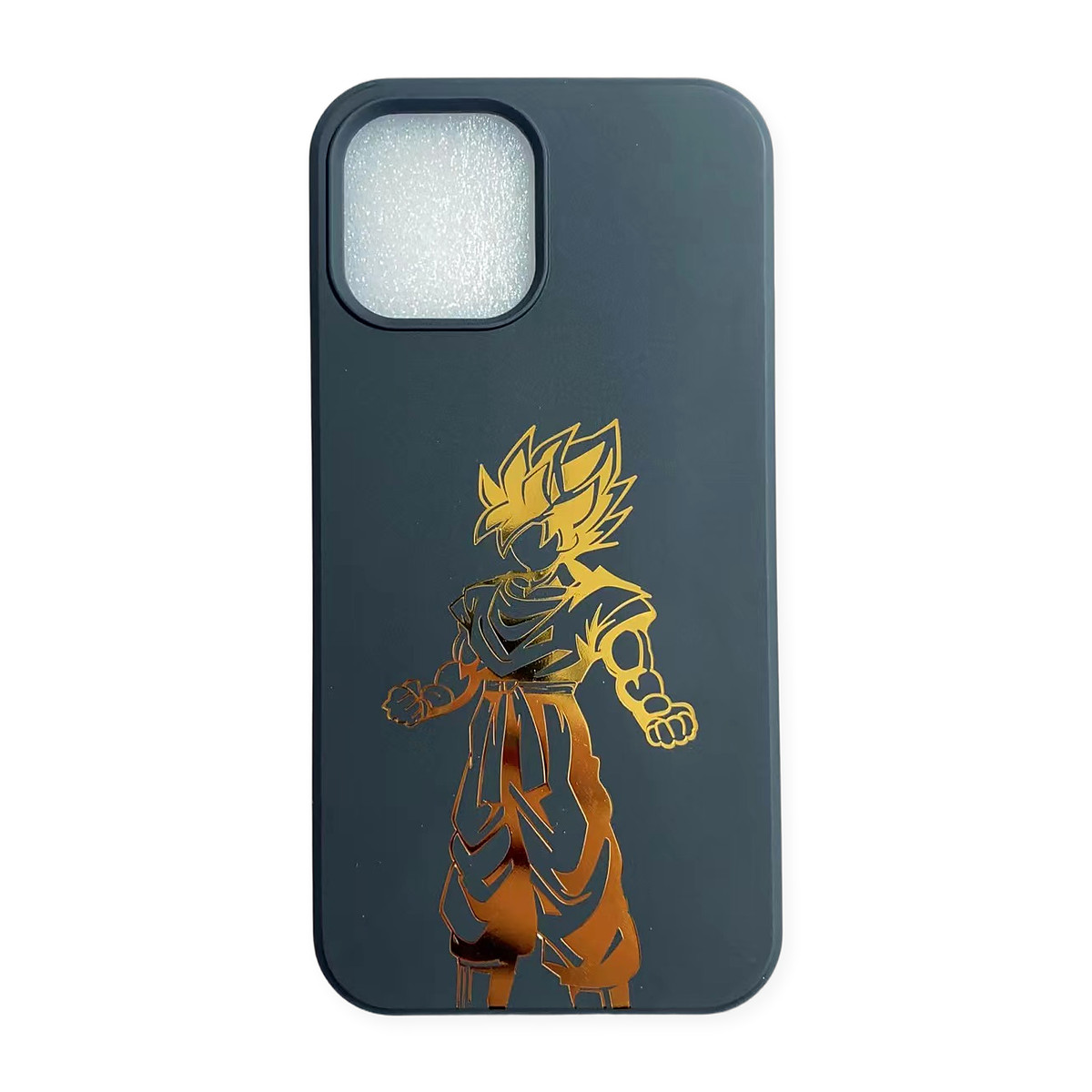
Not every mark needs a full-coverage print. A brand logo on the camera ring, a gold monogram on the back, a raised badge that catches a fingernail — these are shop-floor finishing jobs, and they are priced and run differently from a full print. Four of them live on this page.
Pad printing        small logos on curved edges     plate US$9-30 per colour
Hot foil            metallic gold and silver        plate US$9-30 per colour
Epoxy doming        raised glassy badge              no plate, priced by material
Spray painting      whole-shell colour and texture   no plate, priced by material
1. Pad printing — small marks on shapes a screen cannot reach
A silicone pad picks ink up from an engraved plate and presses it onto the part. Because the pad is soft, it wraps around curves, steps and edges that a flat screen would miss.
- Where it wins: a logo on the camera ring, a mark on a raised button, a small word on a curved side wall — the places where a screen-printed image would break or smear.
- Limit: small areas only. Pad printing cannot lay a large solid field, and each colour is another plate and another pass.
- Feel: flat and thin. If you want the logo to be felt, that is epoxy doming, not this.
2. Hot foil stamping — the metal look without metal
Heat and pressure drive a foil film onto the surface, leaving a metallic layer. Gold, silver, copper and a few specialty foils; the finish is mirror-bright where the stamp lands.
- Where it wins: a premium logo on PU leather, a gold wordmark on a matte PC shell, an edge line that reads as luxury rather than print.
- Limit: the surface has to be flat enough for the die. Heavy texture and deep curvature break the foil. On a shell that flexes, foil can crack along the fold — we tell you before you commit.
- Colour range: whatever foils exist in stock. If your brand colour is a specific Pantone, hot foil will approximate it, not match it.
3. Epoxy doming — a raised, glassy badge
A printed logo is covered with a drop of resin that cures into a dome. The result is raised, glossy and slightly magnifying — the classic look of a brand badge on consumer electronics.
- Where it wins: a small logo that has to be noticed and touched, on a flat panel, at a low tooling cost compared with moulding the shape.
- Limit: it adds height. On a case that has to sit perfectly flat or slide into a tight pocket, a dome is a bump. Resin also yellows over years under UV — ours is UV-stabilised, but “never yellow” would be a promise nobody can keep.
- Size limit: small. A large dome is fragile and looks like a sticker.
4. Spray painting — the colour and texture underneath everything else
The whole shell is painted, usually as the base for another decoration and sometimes as the finished product. Matte, gloss, soft-touch, rubber and metallic finishes all come off the same line with different material.
- Where it wins: a base colour the moulded plastic cannot deliver, a soft-touch hand feel, a two-tone shell with masked areas.
- Limit: two-tone needs masking, and masking is labour. Paint adds a few hundredths of a millimetre — enough to matter on a case built to tight tolerances. Soft-touch finishes show hand marks and need a wipe-down to look new.
- Why it matters: most other decorations sit on top of a sprayed base. If the base is wrong, everything above it looks wrong.
Which effect needs which process
| What you want | Process | Why |
|---|---|---|
| Small logo on a curved edge | Pad printing | The soft pad reaches shapes a screen cannot |
| Gold or silver metallic logo | Hot foil | Real foil film, not metallic ink |
| Raised, glossy brand badge | Epoxy doming | Resin dome adds height and shine |
| Whole-shell colour or soft-touch feel | Spray painting | The only method that colours the whole part |
| Large full-colour graphic | UV printing | None of the four above can cover a large area in colour |
| Thin mark that cannot wear off | Laser marking | Changes the material instead of adding a layer |
How the four are priced
| Process | Set-up | What drives the unit price |
|---|---|---|
| Pad printing | US$9–30 per colour, charged once | Number of colours, print area, how curved the surface is |
| Hot foil | US$9–30 per colour, charged once | Foil type, die area, surface flatness |
| Epoxy doming | None | Resin volume and dome diameter — material and labour |
| Spray painting | None | Coats, masking steps, finish type — material and labour |
Prices in US dollars, converted at RMB 6.67 = US$1. We invoice in USD or RMB at the rate of the day.
MOQ and unit price are quoted against the design, because a 6 mm logo and a 40 mm logo on the same case are not the same job. Send the artwork and we will give you both numbers.
What we need to quote it
- A vector file at final size, and the exact size you want it printed.
- The shell material and finish — foil behaves differently on PU leather and on matte PC.
- Whether the mark is on a flat panel or across a curve. That single answer decides between pad printing and a screen.
- Quantity per design, and whether other decoration is going on the same shell.
If you have been quoted hot foil for a logo that sits across a heavily textured surface, ask how they intend to keep the foil from breaking. On texture, pad printing or a laser mark is usually the honest answer.
These four sit alongside the eight other decoration methods we run. Start with the comparison of all twelve, or go straight to screen printing, IMD, 3D sublimation and in-mould embossing.
Send the logo and the shell. Tell us the size and whether it lands on a flat panel or a curve, and we will quote the right process rather than the one that is easiest for us. Start here — NDA available before you share any file.
Send us what you are making.
Model, quantity and the artwork you already have is enough to start. You get a price range and a lead time within one working day — no account, no ticket queue, no waiting for a form to be read.