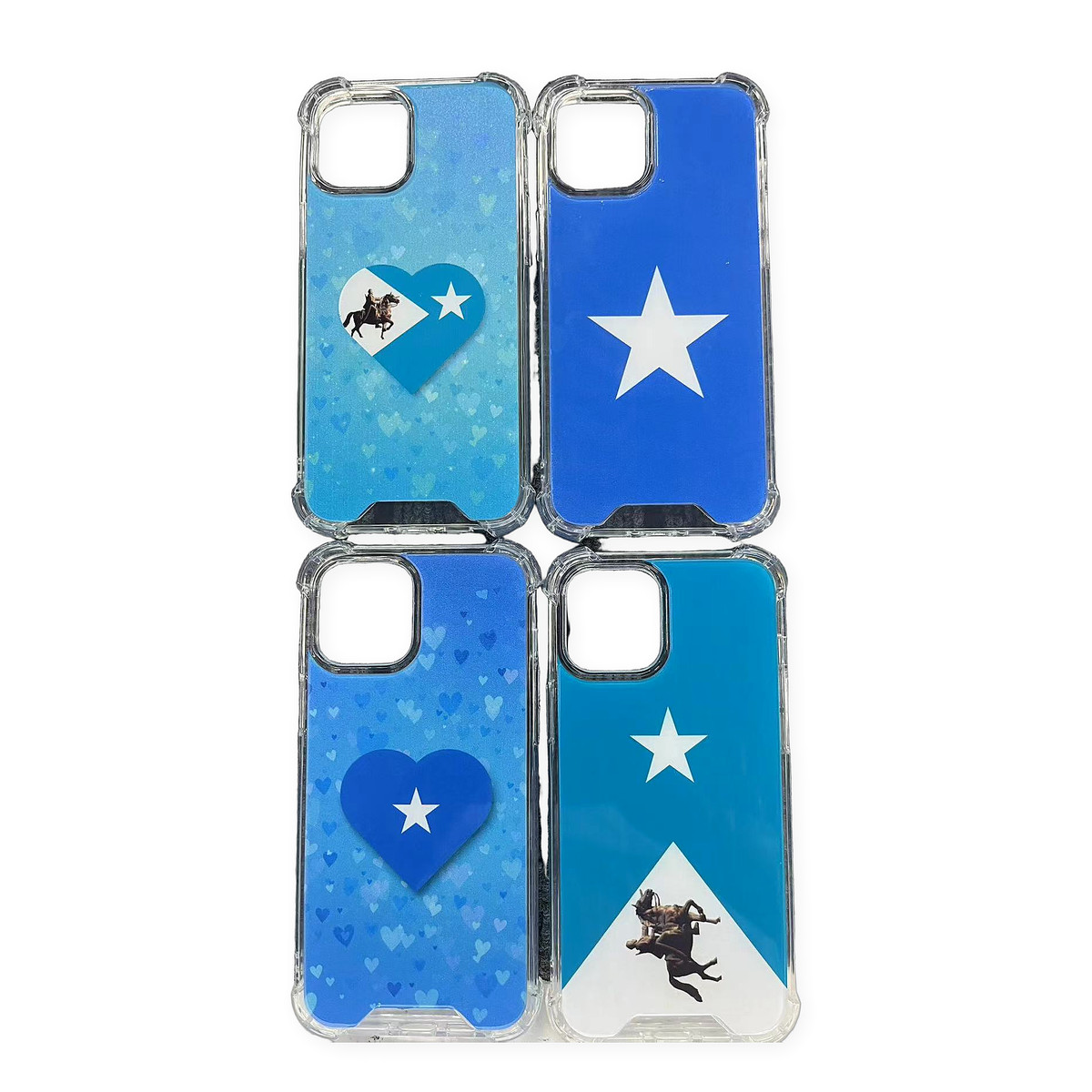
UV flatbed printing sprays cured ink straight onto the shell. No film, no tank, no mould, no screen. That is why it is the cheapest of our four pattern processes and the only one where 10 pieces of a pattern makes sense. It prints the back panel only — if your design has to run around the sides, this is the wrong process and we will tell you so in the first reply.
10 pcs/design    100 pcs/model    3–5 days    US$0.49–0.97
per pattern      per model        sample      TPU / TPU+PC
What a UV flatbed actually does
A print head passes over the shell and lays down UV-curable ink. A UV lamp behind the head cures it instantly — the ink goes from liquid to solid in a fraction of a second, so it cannot run or soak in.
What that gives you:
- No film to print and no tank to set up → almost no fixed cost per design
- No screen or plate → changing the artwork costs nothing
- White ink available → full-colour prints work on black and dark shells
- Multiple passes build height → raised texture without a mould
What it does not give you: the ink sits on the surface. There is no wrap and no protection from the plastic itself.
The lowest entry point we offer
Across our four pattern processes, the minimum per design looks like this:
| Process | Minimum per pattern |
|---|---|
| UV printing | 10 pcs |
| IMD | 20 pcs |
| 3D sublimation | 20 pcs |
| Water transfer | 500 pcs |
And the sample turnaround is the fastest: 3–5 days, against 5–7 for IMD and 7–10 for the other two.
Who this is for:
- A brand testing six designs before committing to a hero product
- A designer who needs a physical sample in a client’s hand next week
- A promotional order where the quantity is genuinely small
- Anyone who wants to see a real shell before paying for tooling or a 500-piece run
How the model minimum works: 100 pieces per phone model is the floor, 10 pieces per pattern is the floor. Ten patterns at 10 pieces each is 100 pieces and satisfies both. Two patterns at 10 pieces each is 20 — that fails the model minimum, so it rounds up to 100.
If your design proves out at 10 pieces, UV is the cheap way to find that out. Once volume arrives, we will usually move you to IMD or sublimation, because the unit price falls and the durability improves.
Embossed UV — texture with no mould
Passing the head over the same area several times builds ink height. We can reach roughly 0.2–0.5 mm of raised surface, which is enough to feel clearly and enough to photograph well.
Works well for:
- A logo that should be felt, not just seen
- Leather grain or canvas texture on a flat shell
- Lettering on a matte background
- Limited-edition packaging sets where touch matters
Keep it away from:
- Large raised areas — thick ink layers can crack when the shell flexes
- High-wear corners — emboss wears faster than flat print
- Anything that has to survive two years of pocket abrasion
It prints the back panel only
This is the single most important limitation, and it decides whether UV is right for you.
The print head works on a flat plane. It cannot follow the shell round the corner. Your design stops at the edge of the back panel; the sides stay bare plastic or sprayed colour.
Combinations that work well:
- Spray the whole shell one colour, then UV print the back
- UV print the back, then screen print a small logo on the side
- Use UV for the back and accept a plain rim
If the design has to continue around the sides, go to 3D sublimation (hard shells, from 20 pcs) or water transfer (any shell, 500 pcs).
Durability — the honest part
UV ink sits on the surface, so it wears. Under sustained friction — a pocket with keys, a bag with coins — the ink scuffs at the edges and the corners first, and eventually dulls across the print.
What we do about it:
- A UV clear coat over the print substantially improves abrasion resistance
- Rounded edge coverage is specified in the artwork file so the ink does not stop at a hard line
- For anything that must not wear, we recommend IMD, where the graphic is behind plastic
What we do not do: claim that a surface print behaves like an in-mould graphic. It does not, and telling you otherwise would only cost you a customer later.
When UV printing is the wrong choice
- Your design must wrap the sides. UV cannot. Sublimation or water transfer.
- The product has to look unchanged after a year of use. Go to IMD.
- You need a soft-touch matte finish across the whole shell. That is spray coating, not printing.
- You are running 5,000 pieces of one design. At that volume flat IMD or screen printing is cheaper per piece.
Specifications
| Item | Detail |
|---|---|
| Substrate | TPU, TPU+PC |
| Coverage | Back panel only — sides not printed |
| Colour | Full colour, CMYK + white |
| Minimum | 10 pcs per design, 100 pcs per model |
| Sampling | 3–5 days |
| Production | 7–10 days |
| Unit price | US$0.49–0.97 |
| Finish | Glossy or matte; clear coat optional |
| Emboss height | 0.2–0.5 mm on request |
| Artwork | AI / PDF / PSD at 300 dpi |
FAQ
Can I really order 10 pieces?
Per design, yes — provided the total for that phone model reaches 100 pieces. Ten patterns at 10 pieces each is a valid order.
Can you print white on a black case?
Yes. White is printed as a base layer, then colour on top. Without it, colours read muddy on dark shells.
How deep can the embossed texture be?
About 0.2–0.5 mm. Beyond that the ink layer becomes prone to cracking where the shell flexes.
Will the print come off in a pocket?
It will wear at the edges over time. A clear coat extends that considerably. If you need a print that cannot wear off at all, IMD is the process — and we will say so before you order.
Do you print on glass or acrylic?
Our UV line is set up for TPU and TPU+PC. Other substrates can be discussed, but they need a different adhesion primer — ask before assuming.
Can I switch to IMD later without changing my artwork?
Yes. Bring the same file and we will check whether the design survives the film-forming step, particularly at the corners on a full wrap.
Send your artwork — 10 pieces is enough to start, and the quote comes back in 24 hours.
Tell us the phone model, how many patterns, and how many pieces per pattern. If you are testing several designs, say so: we will quote them as one order and keep the set-up simple.
On confidentiality: what you send us stays with us. We never disclose your artwork, designs or product information to any third party without your written consent — and we sign an NDA before you share a single file.
Send us what you are making.
Model, quantity and the artwork you already have is enough to start. You get a price range and a lead time within one working day — no account, no ticket queue, no waiting for a form to be read.