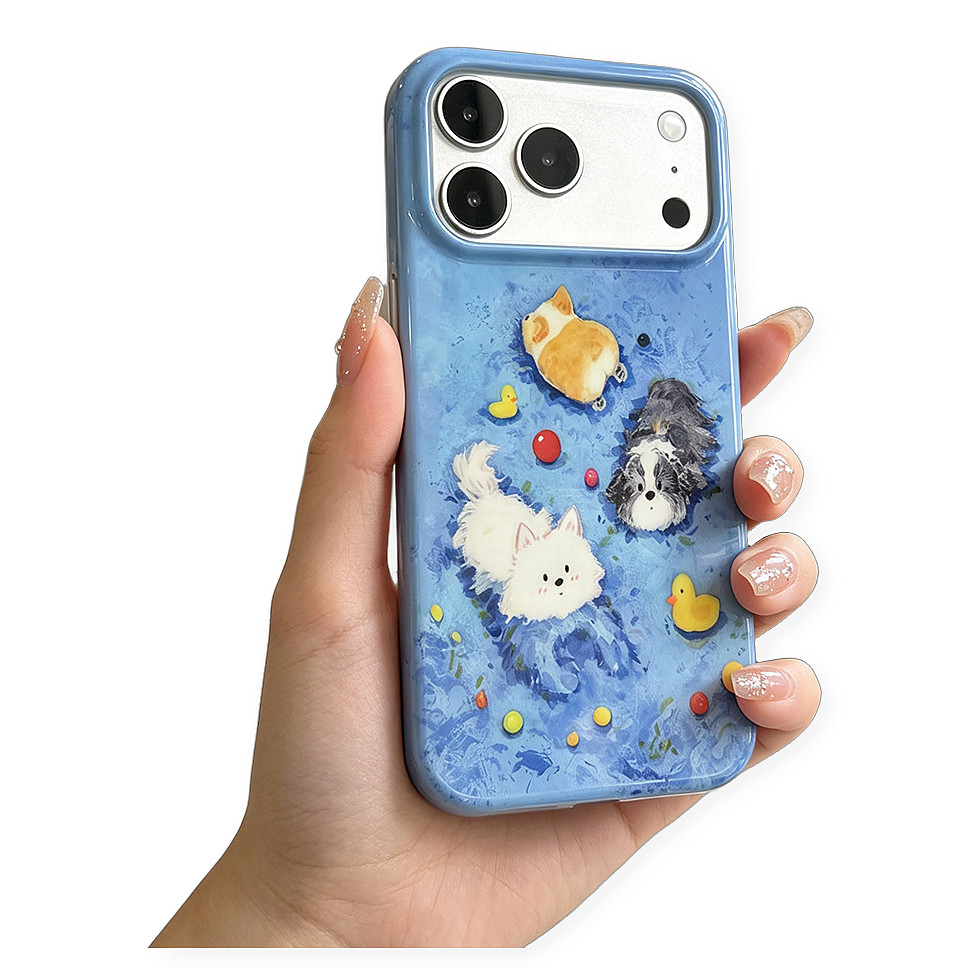
In-mould decoration prints your artwork onto a film, then moulds that film into the wall of the case itself. The ink ends up behind the plastic, not on top of it. There is no coating to wear through, no edge to lift, and no way for a key in your pocket to reach the graphic. We print the film and run the injection in the same building in Guangzhou — and when a new phone model needs tooling, we cut that too, without invoicing you for it.
20 pcs/design    100 pcs/model    5–7 days     US$0.59–1.50
per pattern      per model        sample       TPU
Three kinds of IMD — the difference is how far the pattern wraps
Most suppliers quote “IMD” as one thing. It is not. The three variants share the same principle — ink sealed inside plastic — but differ in how far the film is stretched, and that single variable drives cost, yield and what your pattern can look like.
Flat IMD — back panel only
The film stays flat. No stretching, no thermoforming. The pattern covers the back and stops at the edge; the sides show the shell’s own colour.
- Best yield, lowest cost of the three
- The artwork cannot distort, because nothing is stretched
- The sides have no pattern. On a clear or light shell, the unprinted sides are also where yellowing shows first
Good for: minimal designs, single-colour logos, MagSafe-compatible backs, high-volume runs where the graphic is the whole point and the sides do not matter.
Partial-wrap IMD — pattern climbs 30–40% up the sides
The film is shallow-formed. The pattern runs over the back and continues partway up the side wall, stopping below the buttons. Buttons stay as cut-outs in the shell colour.
- Noticeably better looking than flat, without the cost of a full wrap
- Shallow draw keeps distortion low — complex gradients usually survive
- The lower half of the side wall stays plain. From a low angle you can see where the pattern stops
Good for: the mainstream e-commerce look — cartoon, landscape, illustrated repeats.
Full wrap IMD — 360°, including the buttons
The film is deep-drawn into a true 3D shape, following the corner radii and the button cut-outs. The pattern wraps the back and all four sides continuously, and the buttons carry the graphic too.
- The strongest single-piece look you can get on a phone case
- The pattern also hides the side walls, so yellowing underneath is far less visible on clear shells
- Highest cost, lowest yield. Deep drawing stretches the film unevenly at corners and around buttons — that is where a pattern can thin out or blur
- Dense gradients and fine repeating geometry are the highest-risk artwork for this variant
Good for: streetwear brands, original illustration, marble and continuous textures, high-retail-price products.
| Flat IMD | Partial-wrap | Full wrap | |
|---|---|---|---|
| Pattern on back | Yes | Yes | Yes |
| Pattern on sides | No | 30–40% up | 100%, all four sides |
| Pattern on buttons | No | No | Yes |
| Film forming | None | Shallow | Deep 3D draw |
| Relative yield | Highest | Medium | Lowest |
| Relative unit cost | Lowest | Medium | Highest |
| Distortion risk | None | Low | High at corners and buttons |
| Best artwork | Simple, logo, solid | Illustration, landscape | Marble, continuous texture, bold art |
What actually happens inside the mould
The film starts as a flat sheet, 0.1–0.25 mm thick, printed on the back side — the side that will face the plastic. It is then heated and formed into the shape of the case. In the mould, molten TPU flows behind the film and bonds to it. When the part cools, the printed layer sits between the film and the injected plastic: inside the wall of the case.
That is the whole trick. Everything else follows from it.
- There is no ink on the outside. Nothing to scuff, nothing to wipe off with alcohol.
- The pigment never meets UV or sweat, because it is not on the surface. Colour holds far longer than any printed-on finish.
- There is no edge. The graphic does not sit on the shell like a decal, so there is no thickness step to catch a fingernail.
Why the material follows the wrap
Customers often ask whether we can do IMD on a rigid PC shell. The honest answer depends on which variant you need.
Deep-drawing a film into a full 3D shape requires the shell to flex with it during forming and ejection. That is why full wrap IMD runs on TPU — the soft material tolerates the draw, and the case can be stripped from the mould without cracking the film at the corners. Flat IMD has no draw at all, which is what makes rigid substrates possible.
So: if your design needs a rigid feel and a full wrap, IMD is not the right process — 3D sublimation on a PC shell is, and it costs less per piece. If you want the pattern to be genuinely un-scratchable, IMD on TPU is the only answer.
IMD vs 3D sublimation — where the graphic actually sits
These two are constantly confused, because both can wrap 360° and both are sold as “3D”. The difference is one layer of plastic.
| IMD | 3D sublimation | |
|---|---|---|
| Graphic position | Sealed inside the shell wall | Sintered onto the outer surface |
| Can you feel the print? | No | Yes, a thin coat |
| Scratches off? | No | Under heavy abrasion, eventually |
| Substrate | TPU | PC or PC+TPU |
| Relative unit cost | Higher | Lower |
| Pattern position accuracy | Set by the mould, very consistent | Can shift; not centred like a mockup |
| Minimum | 20 pcs/design, 100 pcs/model | 20 pcs/design, 100 pcs/model |
The decision rule: if the product has to survive two years of pockets without the art fading, pay for IMD. If you want full-wrap colour at a lower unit price and the print sits under a protective coat anyway, sublimation does the job.
When IMD is the wrong choice
We would rather you pick the right process than take an order that disappoints.
- You need 10 pieces to test a design. IMD starts at 20 pcs per pattern. Use UV printing instead.
- Your artwork must reach the very edge, including the outer rim. Even full wrap IMD leaves the extreme rim and the deepest corner radii bare — the film cannot stretch that far. Water transfer printing covers those areas properly.
- You want a soft-touch, rubberised feel. IMD gives you a hard, glossy or matte plastic surface. That finish comes from spray coating, not from the film.
- You need a shell geometry that does not exist yet, and cannot fund a mould. Standard models carry no tooling charge; a brand-new or custom shell does. If that cost is not justifiable at your volume, start with sublimation on a stock shell.
Specifications
| Item | Detail |
|---|---|
| Substrate | TPU |
| Wrap options | Flat / partial-wrap / full wrap |
| Colour | Full colour, CMYK + white base |
| Minimum | 20 pcs per design, 100 pcs per model |
| Sampling | 5–7 days |
| Production | 7–15 days |
| Unit price | US$0.59–1.50, depending on variant and volume |
| Finish | Glossy or matte |
| Artwork | AI / PDF / PSD at 300 dpi, plus a die-line if you have one |
| Mould material | S136 core / 45 steel base |
| Mould life | ~100,000 shots per mould |
| Cavity | 1×1 for all decorated parts |
On the minimum order: 100 pieces is the minimum per phone model, and 20 pieces is the minimum per pattern. Five patterns on one model is 100 pieces and meets both conditions. Three patterns at 30 pieces each is 90 — below the model minimum, so it rounds up to 100.
Tooling — usually there is none
This is the part buyers get wrong most often, so let us be precise.
If your artwork goes onto a phone model we already run, there is no tooling charge and no plate charge. The mould exists. We are changing the film, not the steel. That holds for flat, partial-wrap and full wrap alike — wrap depth changes how the film is formed, not whether a mould is needed.
A mould only enters the picture in one case: you want a custom shell — your own wall thickness, corner radius, button layout or port cut-outs.
When a new phone model is released, we cut the tooling ourselves and absorb the cost into the unit price. You will not receive a mould invoice for a phone model — not for one we already run, and not for one that came out last month. That is not generosity. It is what having a mould shop in the same building allows, and it is why we can quote a brand-new model without adding weeks of tooling negotiation to the front of the project.
It also means every model has to pay for itself eventually, so we choose which models to tool carefully. We will tell you honestly if a model is not worth cutting yet.
For a custom shell geometry, tooling is quoted against the part. The specification below is what that money buys.
What the mould is made of
- Core: S136 stainless steel. It takes a mirror polish and resists the corrosive gases released during moulding — that is what keeps the surface of a decorated part clean run after run.
- Mould base: 45 steel.
- Service life: around 100,000 shots per mould under normal production. At one case per shot, that is 100,000 cases per cavity.
Why we run one cavity for decorated parts
Cavity count is a cost decision — up to a point.
- 1×1 — one formed film per shot, one registration to hold.
- 1×2 / 1×4 — sensible for undecorated or low-tier shells, where per-piece cost matters more than decoration precision.
For IMD we run 1×1. Multiple cavities mean several formed films inside one mould, and every one of them has to land in register on every single shot. That is where yield goes, and yield is a larger number than the machine time you save.
If your project needs the lowest possible unit cost and the decoration is simple, the right conversation is about flat IMD or 3D sublimation — not about adding cavities to a full wrap mould.
We cut moulds in-house, which is why tooling can be quoted in days rather than weeks, and why a T1 sample does not have to travel between three suppliers.
FAQ
Can IMD print a full-colour photograph?
Yes. CMYK plus a white base layer, so the image stays true on dark shells as well.
Does the pattern cover the side walls?
Depends on the variant. Flat stops at the edge, partial-wrap climbs 30–40% up the side, full wrap covers all four sides and the buttons. Tell us which you need before we quote.
What is the minimum order for a new pattern?
20 pieces per pattern, and 100 pieces per phone model in total.
Will the pattern be perfectly centred like my mockup?
Position is set by the mould, so it is consistent from piece to piece — more consistent than heat transfer. But the film does not stretch infinitely: on full wrap, artwork near the corners and button edges can thin slightly. We send a physical sample before production so you approve what you will actually receive.
How long does the mould last?
Around 100,000 shots per mould — S136 core, 45 steel base. At one case per shot that is 100,000 cases. If your annual volume is higher than that, we will quote a heavier steel and a scheduled maintenance interval instead.
Can I see a sample before committing to production?
Yes — 5–7 days, and the sample cost is credited against your first bulk order.
Send your artwork — we reply with a costed quote in 24 hours.
Include the phone model, the number of patterns and the quantity per pattern. If you have a physical sample of a case you like, send a photo; we can usually tell you which variant it was made with.
On confidentiality: what you send us stays with us. We never disclose your artwork, designs or product information to any third party without your written consent — and we sign an NDA before you share a single file.
Send us what you are making.
Model, quantity and the artwork you already have is enough to start. You get a price range and a lead time within one working day — no account, no ticket queue, no waiting for a form to be read.